A slice happens when the clubface is open to the path the club is travelling on at impact. For a right-handed golfer, the ball curves from left to right, often a long way. Fixing it starts with working out whether your problem is the face, the path or both, then changing one thing at a time.
Quick answer: check your grip and aim first, then work on swinging the club more from the inside and rotating through the ball. Left-handed golfers get the mirror image of everything here.
What a slice actually is
Ball flight comes down to two things at impact. The first is where the clubface points, which mostly sets the start line, the direction the ball leaves on. The second is the difference between where the face points and where the club is travelling, known as face to path. That difference creates sidespin, and sidespin makes the ball curve.
If the club is travelling to the left of the target and the face is pointing to the right of that path, the ball spins clockwise and curves right. The bigger the gap, the bigger the slice. Aiming further left only moves the whole problem along, because the face is still open to the path.
Is it a slice, a push or a pull-slice?
Not every ball that finishes right is the same miss, and the cure depends on which one you have. Watch where the ball starts, then where it ends.
| What you see | What it usually means |
|---|---|
| Starts left, curves right | The path is well to the left and the face is open to it. A pull-slice. |
| Starts straight, curves right | The face is square to the target but open to a path that is moving left. |
| Starts right, curves right | The face is open to the target and open to the path. A big open face is the main problem. |
| Starts right, stays right | A push. The path is to the right and the face matches it, so there is little curve. |
Most slices sit in the first two rows. That is why aiming left rarely cures it: it encourages a path even further to the left.
The usual causes
Slices rarely come from one thing. These are the ones we see most often.
- A weak grip. If the hands are turned too far towards the target, it becomes hard to close the face through impact.
- An out to in swing path. The club comes down from outside the line and cuts across the ball, often as a reaction to fearing the ball going right.
- Aim and alignment. Shoulders aimed left of the target encourage a path that travels left.
- Ball position and posture. A ball too far forward, or standing too upright, can leave the face open when it matters.
- Limited rotation. If the body stops turning, the arms take over and the face stays open.
Five things to work on
Change one thing at a time. Trying several fixes in one session usually just creates a new miss.
1. Check your grip first
This is the quickest fix and the one most often skipped. Set your lead hand so you can see two or three knuckles when you look down, and make sure the trail hand sits on the side of the grip rather than on top. A slightly stronger grip makes it easier to return the face square.
2. Square up your alignment
Lay a club on the ground along your toe line and another along the target line. Check your feet, hips and shoulders are parallel to the target line, like railway tracks. Many slicers set up open without knowing it.
3. Feel the club swing out to the right
To fix an out to in path you often need to feel the opposite. Place a headcover just outside the ball and a little further back, and try to swing past it without touching it. That encourages the club to approach from the inside.
4. Rotate through the ball
Let your chest finish facing the target. A body that stops turning leaves the arms to do everything, and the face stays open.
5. Start with a shorter club
Do not try to fix a slice only with the driver. Begin with a seven iron, where the extra loft makes contact easier and the sidespin smaller, then work up once the ball starts straighter.
Reactions that make a slice worse
Some common responses only dig the hole deeper. Aiming further and further left to allow for the curve trains a swing path that travels even more across the ball. Swinging harder makes the open face arrive faster, so the curve gets bigger. Tensing the forearms to hold the face square usually shortens the swing and takes away speed.
Be patient with the change, too. A new feel can send a few shots the other way at first. That is normal, and it often means the face and path are finally getting closer together.
Why measuring beats guessing
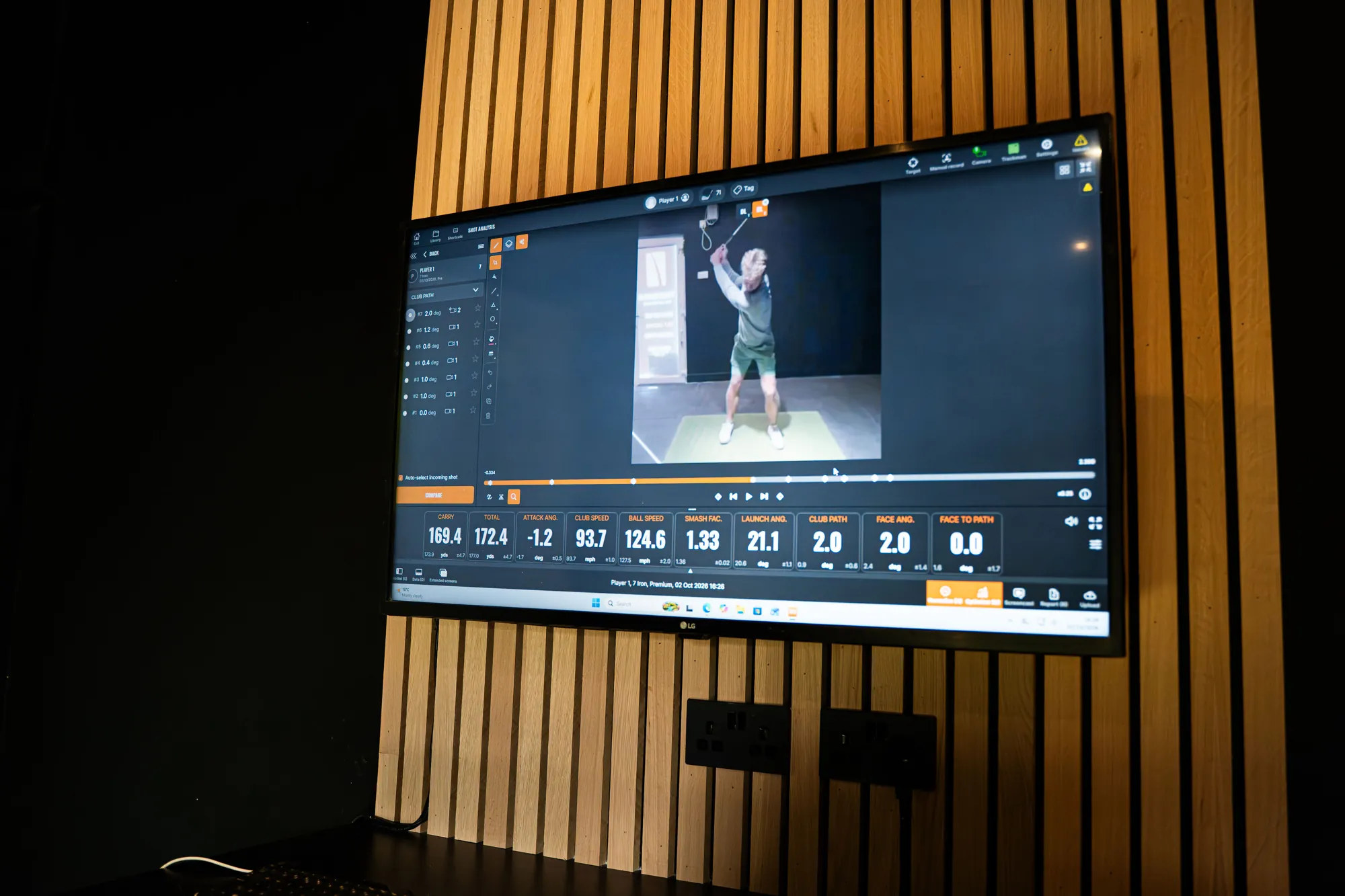
A slice feels the same whether it comes from the face, the path or both, which is why golfers can spend years working on the wrong thing. A launch monitor shows face angle, club path and face to path on every shot. Our guide to understanding your TrackMan numbers explains how to read them, and how TrackMan works covers the basics.
At Evolution Golf Academy, every bay on the TrackMan driving range shows your numbers, and in a lesson in the private teaching bay a PGA Professional pairs that data with video so you can see the cause as well as the result. A one to one lesson is 60 minutes and £55, with TrackMan data and video analysis included. If your body is the limit, our TPI movement screen checks how you move.
A simple practice plan
- Spend five minutes on grip and alignment with no ball, using a club on the ground as a guide.
- Hit ten shots with a seven iron, focusing only on the headcover drill.
- Note where each ball starts and where it finishes.
- Move to a longer club only when most shots start on line and curve a little or not at all.
- Finish with a few shots at a target, at a normal tempo.
Short, focused sessions work better than a huge bucket hit on autopilot. Range baskets start from £4, so you can practise often without it costing much. If you want a structure, our driving range practice plan gives you one.
Want help putting this into practice?
Book a Session